why everyone processes food differently
How your stomach acid, enzymes, and gut bacteria work together, and how this complexity makes your digestion unique
As gut health has become one THE trending wellness topics over the last few years, it has become somewhat of a buzzword and is becoming a movement across the wellness space. With so much noise, this can feel overwhelming and complicated. I want to help clarify some things, starting with what the gut actually is, so you can begin to feel confident with making the right choices for your gut. This in itself will be a bit of a journey but it's worth it I promise.
A lot of us may think that the gut microbiome is just microorganisms that live within our gut, but it is so much more than that.
Gut Microbiota: The collection of microorganisms (bacteria, fungi, viruses, etc.) that live in the gut
Gut Microbiome: Encompasses the microbiota, their genes and their complex interactions with the gut
Your gut microbiome is completely unique to you. Not even identical twins have the same gut microbiome. To put this into perspective: we have around 30 trillion cells in our body, but there are believed to be 40-100 trillion bacterial cells in just our guts. Therefore playing a huge role in how we digest and absorb food, alongside other metabolic activity. It's believed that the microbiome accounts for 99% of all metabolic activity in the body.
Your gut microbiota are just one part of the puzzle that is your gastrointestinal tract, this is basically the road your food takes from entering your mouth to leaving at the other end.
Understanding how our digestive system (microbiota included) works is crucial so you can feel confident and informed when deciding whether something is working for you or not. Your digestive system does more than just break down food, absorb nutrients, and eliminate waste; it's essential for:
Energy production
Growth, cell repair
Immune function (70% of immune cells surround your gut)
Hormone balancing
Weight management
Mental health, and
Overall well-being
This is why we'll take a walk through the gastrointestinal tract (from north to south) so you can understand what's making you unique and the different components that go into your health.
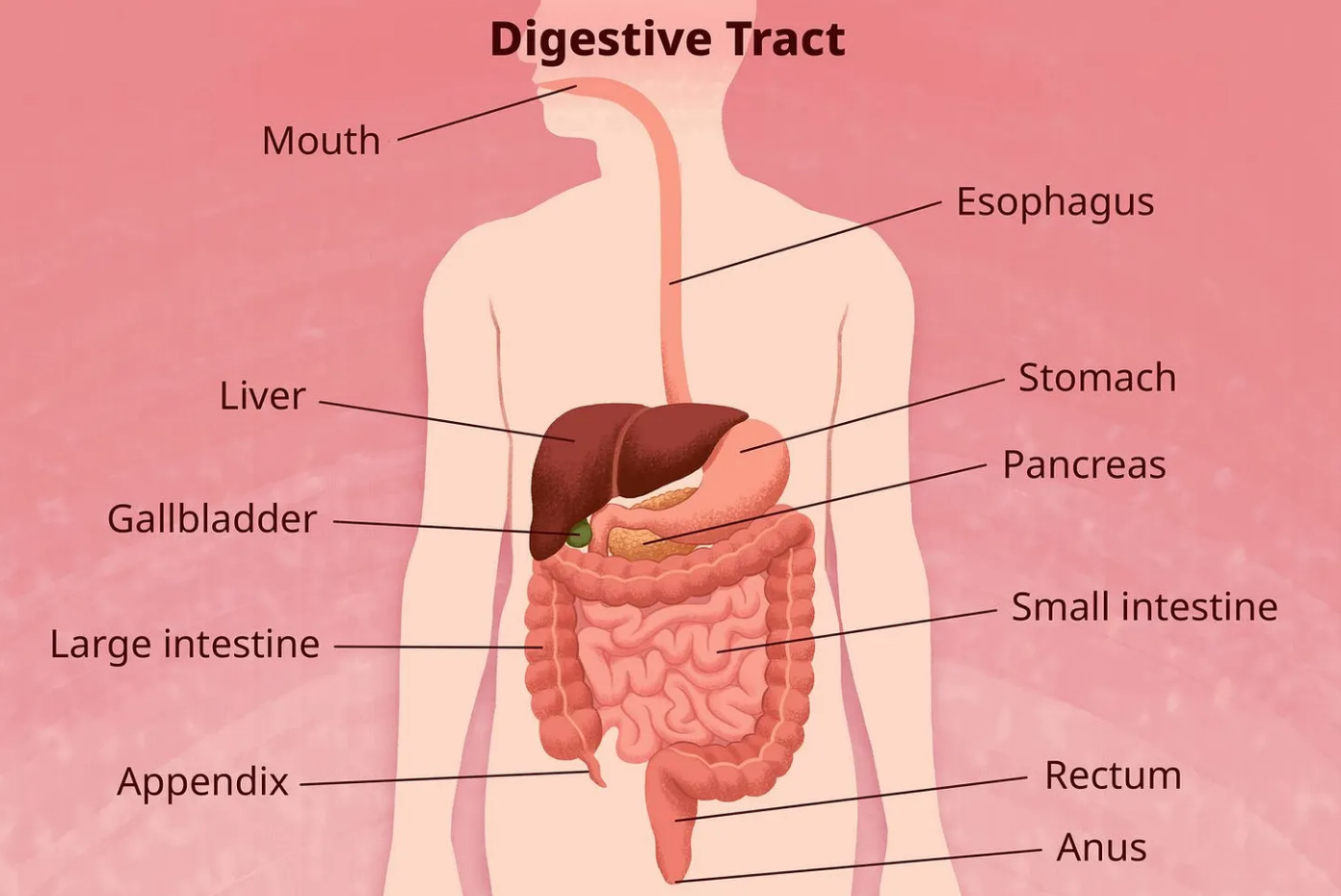
Your gut is around 7 metres long and is technically outside of the body. Think of yourself as a ring doughnut, but the inside is a living, interactive space.
There are two basic elements to how food is digested:
Mechanically, from the movements that send the food through the GI system
Chemically, through chemicals produced from different glands in the body (like hydrochloric acid), enzymes, and bacterial secretions
STEP 1: Anticipation (Cephalic Digestion)
Digestion actually begins before the food even hits your lips. This is called cephalic digestion, and it's when your body is anticipating food, whether that's when you're cooking or sitting down to eat. Through your senses, your salivary glands are stimulated and your stomach starts producing HCl - hydrochloric acid (stomach acid, to put simply), ready for the food.
TIP: This stage can often be overlooked, but consider mindful eating practices to enhance digestion and improve your overall eating experience.
STEP 2: A Bit of Mouth Action
When you put your food in your mouth and start chewing, you are mechanically breaking down the food with the help of the enzymes (biological catalysts which usually breaks molecules apart) in your saliva which start the processes of molecularly breaking down the food as you're chewing, which is a crucial part of digestion.
Saliva is super important at this stage and there are large variations in saliva levels.
TIP: The more you chew, the easier it is on the rest of your digestive system.
STEP 3: Entering The Burning Pit
Once you've swallowed a bite of food, it travels down your oesophagus into the stomach, which is the equivalent of falling into a burning pit that's also a KitchenAid. The acidity of your gastric (stomach) acid means your stomach has to be lined with a thick layer of mucosal cells to protect your insides. Bacterial cells can't really survive in this environment, meaning all of the digestion at this stage is from your stomach acid and pepsin (an enzyme which starts breaking down proteins) and the peristaltic waves (movement) which liquify your food into what we call chyme, ready to flow through the rest of your digestive system.
Here is where some individual differences can influence digestion, some people have naturally high levels of HCl (stomach acid) and have no issues with the initial breakdown of high protein foods at this stage. Others produce barely enough, meaning high protein foods might sit in the stomach like a rock as the stomach acid struggles to get through it.
STEP 4: Chyme Enters The Lazy River (Small Intestine)
Your small intestine is made of 3 parts: the duodenum, jejunum, and ileum each area plays its own part in the function of the small intestine. This is where most (90%) of your absorption of nutrients occurs, and also where chemical digestion is completed. Pancreatic enzymes (lipases, amylases and proteases) finish breaking down fats, complex carbohydrates and proteins.
The Small Intestine Absorbs:
Monosaccharides (glucose, fructose, galactose)
Amino acids and small peptides
Fatty acids and fat-soluble vitamins (A, D, E, K)
Water-soluble vitamins (B complex, C)
Minerals and electrolytes
About 8-10 litres of water daily
The small intestine is essentially your body's primary nutrient extraction facility. If it's not working optimally (due to inflammation, enzyme deficiencies, transit time issues, etc), you won't get the nutrients from your food regardless of how "healthy" your diet is on paper.
Different enzyme levels in your small intestine can be the reason why you can’t get through a milkshake without reaching for the lactase tablets but your other half is perfectly fine! Enzyme levels can be influenced by what you feed your microbes, but that's another topic.
For most people with healthy guts, microbial effects in the small intestine are minimal compared to enzymatic digestion and absorption. For those with slower transit time or SIBO (small intestinal bacterial overgrowth), bacterial fermentation can begin to happen here, causing discomfort. The real microbial action happens in the large intestine.
The Large Intestine: Processing Hub
The large intestine's functions are very different from the small intestine's, as this is where the chyme is processed one last time, once most nutrients have been absorbed.
The bacterial population is 1000x higher in the large intestine (colon) than in the small intestine. The bacteria synthesise some vitamins such as vitamin K and some B vitamins, but their main role is to ferment:
Undigested carbohydrates (resistant starches, fibres - from plants)
Proteins that escaped small intestine digestion
Mucus produced by the colon itself
This is your personal fermentation brewery. The bacterial fermentation of undigested carbohydrates produces short-chain fatty acids such as butyrate, propionate, and acetate, which fuel your colon cells for metabolic activity (such as glucose regulation, immune cell function, and even the stimulation of the production of satiety hormones like GLP-1).
Because of the high bacteria count, around 70% of your immune cells surround the large intestine, this microbiome plays a pivotal role in training the immune system with the complex interactions that occur.
As the chyme passes through your large intestine, water and electrolytes are absorbed, concentrating the chyme (at this stage is just fibre and undigested proteins) into stool, which is stored until it is ready to exit. Transit time varies hugely (12 hours to 3+ days), affecting how much fermentation occurs and which metabolites are produced.
TIP: A high-fibre diet feeds your beneficial bacteria and can improve butyrate production. Gradually increase your fibre intake (your goal should be around 30g a day) to give your microbiome time to adapt. Start slowly and listen to your body, what feels energising for one person might cause initial discomfort for another until bacterial populations adjust.
Extra parts of your digestive system:
Liver - produces bile, processes absorbed nutrients, and filters toxins before they enter the bloodstream
Gallbladder - stores and concentrates bile produced by the liver and used in the small intestine
Pancreas - produces enzymes and bicarbonate to neutralise stomach acid as chyme enters the small intestine
SPHINCTERS - basically flappy passages that ensure the process only flows in one direction
Your digestive tract is also connected to your brain via the gut-brain axis, which hosts bidirectional communication and actually 90% of the communication is messages coming from the gut to the brain. There's essentially a mini nervous system within your gut that signals for behaviours or certain responses via hormones, immune signalling molecules, and the autonomic nervous system. This is something I am really looking forward to learning more about.
Each part of the gastrointestinal tract deserves its own spotlight moment, but I wanted to give you a general overview of all the components in this system and to highlight that there are SO many different areas that can affect your individual digestion. From how long it takes for food to pass through your small intestines, whether the mucosal lining of your stomach is thick enough, down to what microbes make up the population within your large intestines.
Understanding your own digestive system, I believe is the first step towards making informed decisions about what works for your unique body, not what works for someone else's highlight reel. Before I started this course, I knew of the different areas in the GI tract, but I hadn’t really related the complexities and how this holistically affects an individual's digestion. I guess I would have said there would be a one-size diet that could work, but unfortunately, that isn't reality.
So when Instagram Wellness Guru #47 tells you their morning routine will change your life, remember: they're working with completely different digestive machinery than you are. They're living a completely different life to you. They are not you.